


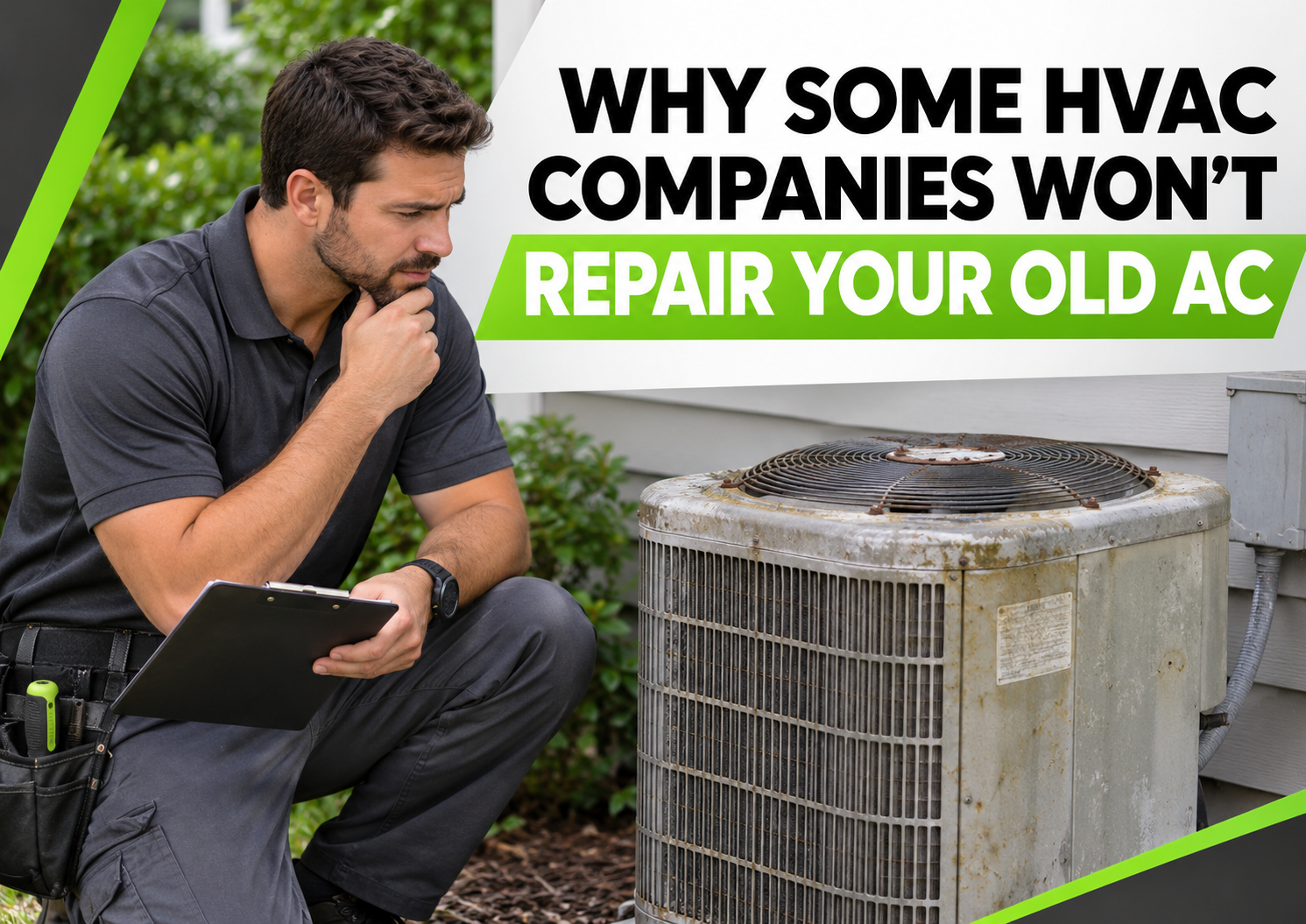
And why it’s not always about selling you a new system.
If you’ve ever had an HVAC company recommend replacing your aging air conditioner instead of repairing it, you might have wondered whether the recommendation was really necessary.
After all, if a technician knows how to fix the problem, why wouldn’t the company agree to do the work?
It’s a fair question. And while homeowners should absolutely feel comfortable questioning an expensive replacement recommendation, there are legitimate reasons why some HVAC companies hesitate to work on very old equipment, particularly systems that still use R-22 refrigerant.
The answer isn’t always about making a sale. Sometimes, it’s about the risks involved in repairing equipment that has already exceeded its expected service life.
First, What Is R-22, and Why Does It Matter?
R-22, commonly known by the brand name Freon, was widely used in residential air conditioning systems for decades.
Because R-22 contributes to ozone depletion, the United States gradually phased out its production and importation. As of January 1, 2020, newly produced or imported R-22 could no longer be used to supply the U.S. market.
However, existing R-22 air conditioners are still legal to operate and repair. Contractors can continue servicing them using previously produced or reclaimed refrigerant.
The challenge is that R-22 has become more expensive and can be harder to source. Additionally, replacement parts for older equipment may be obsolete or difficult to obtain.
But refrigerant availability is only part of the story.
Repairing One Problem Can Reveal Another
An air conditioner that’s been operating for 25 or 30 years has experienced thousands of heating and cooling cycles, temperature changes, vibrations, and exposure to moisture.
Over time, components naturally deteriorate.
Metal parts may corrode. Plastic components can become brittle. Electrical connections may weaken. Drain pans can crack or rust, and refrigerant lines or coils may develop leaks.
Now imagine a technician is called to repair one relatively minor problem on a system that’s nearly 30 years old.
During the repair, the technician may need to disconnect, move, or otherwise work around components that have become fragile with age. Even when proper procedures are followed, working on deteriorated equipment can reveal additional problems or, in some circumstances, contribute to the failure of an already compromised component.
Suddenly, what appeared to be a straightforward repair can become something much more complicated.
This doesn’t mean older equipment should never be repaired. It means the overall condition of the system matters just as much as the specific problem being addressed.
The Liability Issue Homeowners May Not Realize
Here’s something many homeowners may not consider: When an HVAC company agrees to repair an aging system, it can also expose itself to significant financial and legal risks.
Consider an older air handler installed in an attic.
A technician is called to address a drainage issue. The repair is completed, but another deteriorated component or pre-existing drainage problem later causes water to leak into the home.
That leak could damage ceilings, insulation, drywall, or flooring.
Naturally, the homeowner may associate the damage with the recent HVAC service visit. But determining whether the damage resulted from improper workmanship, an unrelated equipment failure, or an existing condition isn’t always straightforward.
Disputes like these can be costly and stressful for everyone involved.
HVAC contractors are responsible for performing their work properly, regardless of a system’s age. However, they cannot guarantee that every other aging component will continue functioning after a particular repair.
This is one reason some companies establish additional precautions or decline certain repairs on equipment that has significantly deteriorated.
Sometimes, the Technician Really Does Want to Fix It
Here’s something worth knowing about HVAC technicians: many genuinely enjoy the challenge of repairing older equipment.
Diagnosing a difficult problem, identifying a failed component, and bringing an old air conditioner back to life can be incredibly satisfying.
For experienced technicians, troubleshooting is a skill they’ve developed over years of hands-on work. Not every technician wants to replace a system simply because it’s old.
But there’s an important difference between knowing how to perform a repair and determining whether that repair is advisable.
A technician may be confident in their ability to address the immediate problem while still having serious concerns about the equipment’s overall condition.
And sometimes, the most responsible recommendation is to leave the system alone.
Why Some Companies Require a Signed Waiver
Some HVAC companies may agree to work on aging equipment only after explaining the risks and asking the homeowner to sign a written acknowledgement.
This can sound alarming, especially when the homeowner is simply trying to get their air conditioner working again.
But the purpose of a properly written acknowledgement is to make sure both parties understand the condition of the equipment, the scope of the proposed repair, and the possibility of additional failures.
For example, a company might explain that replacing a failed component does not guarantee the continued operation of other aging parts.
A signed acknowledgement documents that those limitations were discussed before work began.
Importantly, this shouldn’t be confused with giving a contractor permission to perform careless work. A contractor remains responsible for its workmanship, subject to applicable law and the terms of the agreement.
And in some situations, a waiver may not be enough. A contractor may determine that the equipment’s condition makes the proposed repair too risky to undertake at all.
How Klimatology HVAC Approaches Repairs on Older Systems
At Klimatology HVAC, we don’t automatically recommend replacing an air conditioner simply because it’s old or uses R-22 refrigerant.
We evaluate older equipment on a case-by-case basis.
If a system appears to be in reasonably good condition and the proposed repair is appropriate, we may offer to complete the work after explaining the potential risks and obtaining a signed acknowledgement from the homeowner.
However, there are circumstances where our service manager may determine that a repair presents too much risk to proceed.
Our decision depends on factors such as the equipment’s condition, the nature of the repair, the availability of replacement parts, and the likelihood of additional problems.
We understand that replacing an HVAC system is a significant expense. We also recognize that some homeowners would prefer to keep their existing equipment running as long as reasonably possible.
We respect that decision whenever we can responsibly support it.
But we also believe it’s important to be upfront when a repair may not be the best course of action.
What Should You Do If an HVAC Company Refuses to Repair Your System?
If a contractor tells you that your air conditioner is too old to repair, don’t hesitate to ask questions.
Start by asking why the company is declining the work. Is the necessary part unavailable? Is the refrigerant prohibitively expensive? Has the technician identified extensive deterioration or a safety concern? Or does the company have a policy against performing certain repairs on older equipment?
Understanding the reason can help you make an informed decision.
You can also ask whether a limited repair is possible, what risks it would involve, and whether the company would recommend obtaining a second opinion.
In some cases, another qualified contractor may be willing to perform the repair. That doesn’t necessarily mean the original company was wrong to decline it. Different companies may have different risk tolerances, service policies, and assessments of the equipment.
The important thing is finding a contractor who is transparent about both the possibilities and the limitations.
The Bottom Line: Old Doesn’t Always Mean Unrepairable
Just because an air conditioner is old doesn’t mean it automatically needs to be replaced.
Some older systems remain in surprisingly good condition and may have years of useful operation ahead of them. Others have deteriorated to the point where continued repairs become increasingly unpredictable, expensive, or risky.
There’s no single age at which every air conditioner becomes unrepairable.
And while homeowners are right to be cautious about unnecessary replacement recommendations, it’s also worth understanding that a contractor’s refusal to perform a repair isn’t necessarily a sales tactic.
Sometimes, the decision not to repair an old air conditioner is based on professional judgment, not a desire to sell a new one.
At Klimatology HVAC, our goal is to provide honest assessments and help homeowners make informed decisions about their heating and cooling systems.
Whether that means repairing existing equipment or recommending replacement, we believe homeowners deserve to understand the reasons behind our recommendations.
Have questions about an aging air conditioner? Klimatology HVAC serves homeowners throughout Raleigh, Cary, Apex, Durham, Morrisville, Chapel Hill, and surrounding communities. Contact our team to schedule an assessment of your heating and cooling system.