


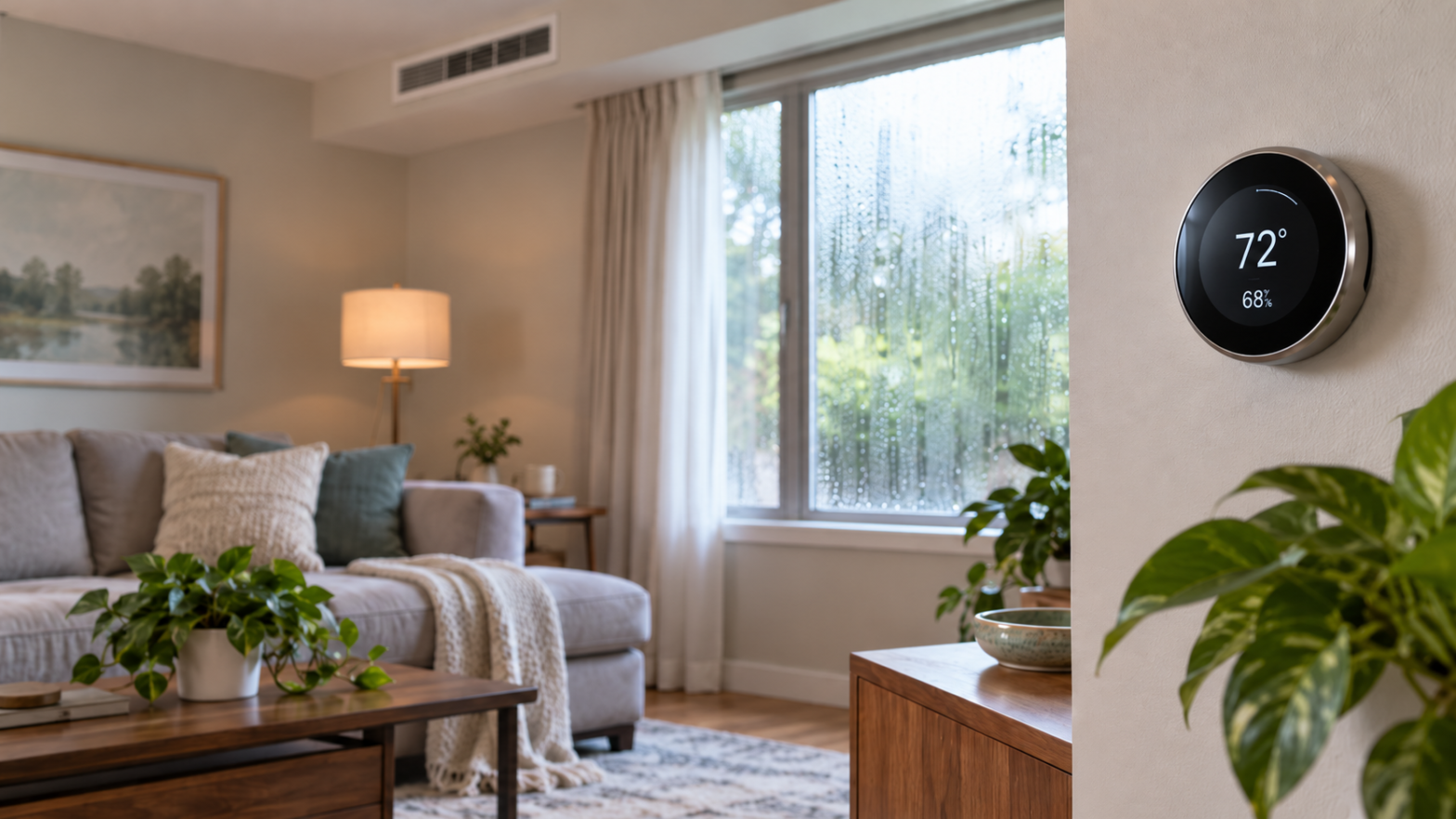
If your house feels humid even when AC is running, you’re not imagining it. This is a common problem for homeowners throughout Raleigh and the Triangle, especially during North Carolina’s hot and humid summer months.
Your air conditioner may be lowering the temperature, but cooling your home and controlling humidity are not exactly the same thing. A properly operating AC system should remove some moisture from the air as it cools your home.
What Should Indoor Humidity Be?
For most homes, indoor relative humidity should generally stay between 30% and 50%.
Once humidity starts climbing above that range, your home may begin to feel warmer and less comfortable—even if the thermostat says the temperature is where you set it.
Signs of excessive indoor humidity can include:
- A sticky or clammy feeling
- Condensation on windows or vents
- Musty odors
- Rooms that feel warmer than the thermostat reading
- Damp-feeling bedding, furniture, or clothing
- Mold or mildew growth
- Increased dust mite activity
If your home consistently feels humid with the AC running, it’s worth figuring out why.
1. Your AC May Be Oversized
It might sound like a bigger air conditioner would cool your home better, but bigger is not always better.
An oversized AC system can cool the temperature in your home very quickly and then shut off before it has enough time to remove moisture from the air.
This is known as short cycling.
Air conditioners need sufficient run time for moisture in the indoor air to condense on the evaporator coil and drain away. When the system repeatedly turns on and off too quickly, your house may reach the thermostat temperature while still feeling humid.
Proper HVAC sizing is especially important in North Carolina, where moisture removal is a major part of keeping a home comfortable.
2. Your AC Isn’t Running Long Enough
Even if the system itself isn’t oversized, anything that causes unusually short cooling cycles can reduce dehumidification.
Possible causes include:
- Thermostat problems
- Incorrect thermostat settings
- Improper system setup
- Airflow problems
- Equipment performance issues
Your AC doesn’t just need to produce cold air—it needs enough operating time to pull moisture out of your home.
3. Airflow May Be Too High
Airflow plays an important role in both cooling and humidity control.
If air moves across the evaporator coil too quickly, the system may cool your home without removing as much moisture as it should.
HVAC airflow should be properly matched to the equipment and the home. This is something a technician can evaluate by checking blower settings, static pressure, ductwork, and overall system performance.
Simply changing blower speeds without properly testing the system is not recommended.
4. Your Evaporator Coil May Be Dirty
The indoor evaporator coil is where your AC removes both heat and moisture from the air.
When the coil becomes coated with dirt or debris, heat transfer can suffer and the system may not remove moisture as effectively.
A dirty coil may also contribute to:
- Longer run times
- Reduced cooling performance
- Higher energy bills
- Poor airflow
- Ice formation on the coil
Regular HVAC maintenance can help identify coil and airflow problems before they turn into larger repairs.
5. Your AC May Have a Refrigerant Problem
Low refrigerant can affect the evaporator coil’s ability to properly absorb heat and remove moisture.
You may also notice:
- Your home isn’t cooling properly
- The AC runs for long periods
- Ice forms on the refrigerant lines or indoor coil
- Air from the vents isn’t as cold as usual
- Energy bills suddenly increase
Refrigerant does not normally get “used up.” If a system is low on refrigerant, there may be a leak that needs to be diagnosed rather than simply adding more refrigerant.
6. Outside Humidity May Be Entering Your Home
Sometimes the AC isn’t the only issue.
Hot, humid outdoor air can enter through:
- Leaky windows and doors
- Poorly sealed attic access
- Duct leaks
- Crawlspace moisture
- Gaps around plumbing or electrical penetrations
- Frequently opened exterior doors
If humid outdoor air is entering faster than your HVAC system can remove the moisture, indoor humidity may remain high.
This can be especially noticeable during Raleigh’s most humid summer weather.
7. Your Ductwork Could Be Leaking
Leaky ductwork can create more problems than simply losing conditioned air.
If return ducts run through a humid attic, crawlspace, or other unconditioned area, leaks may actually pull hot, humid air into the HVAC system.
That moisture can then be distributed throughout your home.
Duct problems can also reduce airflow and make the entire system work harder to maintain comfort.
8. Everyday Activities Add More Moisture Than You Think
Your HVAC system also has to deal with moisture created inside the home.
Common sources include:
- Long hot showers
- Cooking
- Running the dishwasher
- Drying clothes
- Indoor plants
- Large numbers of occupants
- Bathroom exhaust fans that aren’t used or aren’t vented properly
Bathroom and kitchen exhaust fans should vent moisture outdoors—not into an attic or another enclosed space.
When Is High Humidity a Sign of an HVAC Problem?
A humid day outside doesn’t automatically mean something is wrong with your AC.
But if your home regularly stays above roughly 55–60% relative humidity, feels uncomfortable despite reaching the thermostat setting, or suddenly becomes much more humid than it used to be, it may be time to have the system evaluated.
An HVAC technician can check:
- System sizing
- Refrigerant levels
- Evaporator coil condition
- Blower speed and airflow
- Duct leakage
- Drainage
- Thermostat operation
- Temperature and humidity performance
Finding the actual cause is important because simply lowering the thermostat usually doesn’t solve an underlying humidity problem—and may increase your energy bill.
Do You Need a Whole-House Dehumidifier?
Not every humid home needs one.
The first step should be making sure your existing HVAC system is operating and configured correctly.
However, some homes simply have a higher moisture load than the AC system can comfortably handle. In those situations, a whole-house dehumidifier can provide additional humidity control without forcing you to constantly lower the thermostat.
It can be especially useful for homes with moisture-prone crawlspaces, tight construction, challenging duct layouts, or persistent summertime humidity.
Still Feeling Humid With the AC Running?
If your Raleigh-area home feels sticky even though your air conditioner is running, don’t assume you just need to turn the thermostat lower.
There may be an airflow, equipment, ductwork, refrigerant, or moisture-control issue behind the problem.
At Klimatology HVAC, we help homeowners throughout Raleigh, Durham, Cary, Chapel Hill, Morrisville, and the surrounding Triangle area diagnose cooling and indoor comfort problems and determine the right solution for their home.
Whether your system needs a simple adjustment, repair, maintenance, or additional humidity control, we’ll help you understand what’s happening before recommending the next step.
Contact Klimatology HVAC today to schedule HVAC service and get your home feeling comfortable again.